Retreat to your exits, AI agents are coming. Putting the "content" in discontent, (de)generative AI buried everything in slop this year, only some of it output by the bots themselves. But a rhetorical resistance emerged: the concept of ensouled behaviour. Ensouled, the product of one having a soul, i.e. all that should be right and good in the world. That can't be just anything produced by humans: plenty of stuff made by people is downright abysmal. But maybe we stumble on a concept similar to the Bene Gesserit's concept of "humans" and "animals". So maybe we can say being human isn't enough to be ensouled, but exemplifying humanity is. Here are some of the things that I felt were ensouled, and some that left me unsold, in this year, the big 2025.
Ensouled
Slop (noun)
Slop, sludge, enshittification - we're innovating in the space of Words To Describe How Fucked We Are, almost as quickly as we're inventing new ways to get fucked. "Slop", if we're being really honest, is a thought-terminating cliche, but maybe the first one that describes something as meaningfully as it deserves. Like "clanker" (derogatory), it infuses a rebellious silliness into something that inherently does not deserve seriousness. One of the most ensouled experiences you can have online today is bullying a generator of slop. Creating a social consequence is your duty to humankind. This is abolitionist behaviour: if you don't want everyone to be cops about everything, you have to deal with this at a community level. "Slop" is the atomic wedgie that never snaps, the wet willy that is always wet. Only YOU can prevent slop.
Andor, Season 2
They finally made a good Star Wars. I have nothing to say about this that hasn't already been said, except that for someone who always thought Adorno might've been right in that truly subversive art would never be allowed in the mainstream, I was shocked at how legitimately dangerous Andor felt.
Orion's Six Hour Liquid DnB/Jungle Mixes on YouTube
Orion: nine people pumping out a truly unbelievable amount of music. These extended mixes and their accompanying retrostalgic early aughts magazine aesthetic have filled my apartment for months. Inside me, the ghost of a music journalist yearns to know who they are and how they do it, but it might be better for the mystery to prevail.
Self-Hosting Everything
Did you know you can cancel all your streaming subscriptions and just run a Jellyfin server on your computer for free? That way you can watch all your DVDs and home videos whenever you want. You can put music on there too and there are some pretty good apps you can use to stream it from your phone. Did you know you don't have to use any of the water-guzzling, poisonous gas cloud-emitting AI chat bots, you can just run your own? You can't escape surveillance capitalism, but you can mitigate some of your dependency on it if you're willing to learn. I've been sort of cooking something about how a level of Computers Knowledge is a skill like knowing how to cook or garden or fix things around the house, an enabling skill that not only solves problems for you but also lets you contribute to your community. This isn't gonna be that, yet, but think about that.
Wagwan brudda gwan gimme a curry goat rice and peas
High key ensouled.
Music Streaming Co-Ops
In the rush to flee Spotify this year, a couple of alternatives like Resonate and Subvert swam to the discursive shore. The USP was a new economic model for awarding artists through profit-sharing. Great! But after what I watched happen with Mastodon's soft relaunch, relying on an unfamiliar reframing of the social/economic paradigm as a reason to switch is too much for people to chew on. That said, the future of the web, I hope, lies in abandoning the mass mastication, zero-sum, network effects death grip of what Web 2.0 became.
Maybe it doesn't matter that everyone won't get it. Maybe the aim instead is lots of little groups of people using different things that can all speak to each other (interoperability) rather than trying to get everyone on the same platform by being everything to everyone, i.e. nothing to anyone (except arms dealers I guess). I hope that if these platforms are willing to brew over the thorny economic stuff, that means they have the capacity to think about these other issues too, because it seems to me like the only missing ingredient that would actually genuinely threaten the major streaming platforms. I hope it works out for them regardless.
Dami Lee's Architecture Videos
Sometimes I remember that I think solarpunk is really stupid and while scrambling to back that up earlier this year, I started watching a lot of Dami Lee's videos about architecture. Lee is a whip at bringing the history and practice of architectural design into its political and social outcomes like when I used to read Kate Wagner's old mcmansionhell blog, I found Lee's analysis creeping into how I approached fictional worlds this year.
These Delightful Websites
Dr. Stephane Pigeon has spent a lot of time recording sounds and myNoise has a bunch of tools for playing with them. I spent a ton of time cranking knobs this year on the Irish Coast to get the perfectly pleasant mix of wind, waves, and rain. More abrasive but no less delightful, this archive of keygen music sucked away hours of exploration through the noise of digital piracy. But in the visual realm, you might also love OpenBenches, a global map of benches with crowdsourced photos and comments. Coming across some of these comments I felt something similar to reading the comments under classic songs on YouTube. These small markers people have left along the obscure paths of their journey through the internet are sentimental to me in a way I can't describe.
He's Sart of Like an Evil Porson
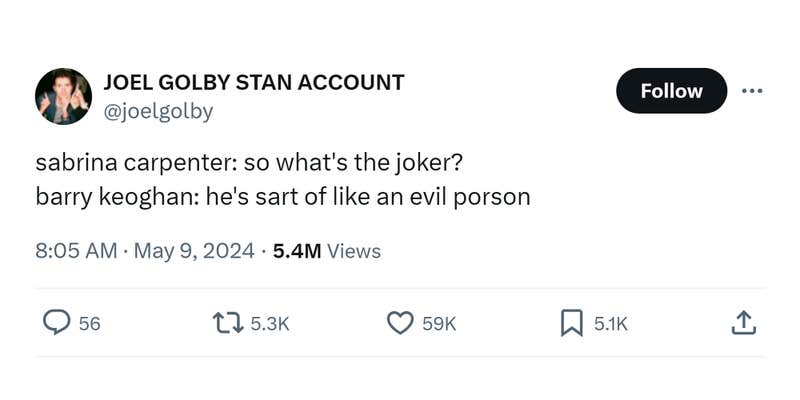
A late runner for one of Twitter's all-timers. I still miss what peak Twitter was like years ago and seeing tweets like this, I sometimes wonder if there's life yet left on the platform. Friends still active there tell me there isn't, so, so much for that I guess. But especially given Sabrina Carpenter's generational run on pop this year, I couldn't stop thinking about this one. Barry, you fucking idiot.
Dana and the Wolf
I had a wonderful polyamorous relationship once. I'm sure I'd do it again, even though (especially because?) I'm wiser to the challenges now. Dana and the Wolf is nothing like the relationship I had, but some of it is a bit, and mostly I appreciate that even when it's salacious, it's mostly a pretty grounded take on navigating that kind of thing. It's also just really compelling, tightly scripted, brilliantly performed. A YouTube series feels like a relic but Dana and the Wolf makes a strong case for the form.
Gay Witches in Space
Turns out you can get real mileage for book reccos by searching "books like broken earth reddit". N. K. Jemisin's trilogy rocked me a few years ago and as a barometer for Books that are Very My Shit, /r/books had my number. This led me to Laurie J Marks's Elemental Logic series which I chewed through in a month as well as Ann Leckie's Imperial Radch series, clocked in about the same time. Marks is a beautiful world-builder and by the end of Elemental Logic, I felt attached to the history and geography of Shaftal, but her greatest strength is in how nurturing and sincere her relationships are. The setting kind of begs for a Game of Thrones-style adaptation, but the sense of care and tenderness make me think something in the realm of Ghibli would evoke it better.
Leckie's world is far more harsh, but like LeGuin's sci-fi, she turns questions of gender and familial closeness into commentary on community and society. I came for the space opera but I stayed for the Marxist uprising. For a while I bumped between space and sorcery: I finally finished the Dune series after God Emperor left a rotten taste and found the focus on the Bene Gesserit in the last two books a blessing. Then Johnathan Strange & Mr Norrell sucked me back into a dark world of magic. Susanna Clarke's ability to craft prose feels literally ensnaring, a trait that continues in Piranesi (and how appropriate) which I also couldn't put down. I went back to space with Liu Cixin's Remembrance of Earth's Past trilogy, which like Strange & Norrell left me downright freaked out at multiple points along the way. And then I read like twelve Warcraft books which were all different degrees of terrible.
Can't all be winners.
Rest of World's Digital Divinity Series
Just a gorgeous piece of reporting on the melding of technology and mysticism. Fans of Dune, 40K, Neuromancer etc. should understand the potency of this combo, and will find a lot to love in this tour through the world's religions and their uses for the machine gods. It's also just stunningly laid out, a real testament to the ability for the web to present writing.
Sergio Cilli's "Director Auditions AI Actor" Series
Obviously I think generative AI is really pathetic, a conviction bolstered by actually having used it a lot. I've seen the limits myself; you hit 'em way, way short of where the mouthbreathing gooners of AI advocacy allege. Sergio Cilli's clips are a pretty effective demonstration: it is impressive to generate an ostensibly realistic-seeming animated person, but ask it to do anything meaningful and it falls apart. If you're normal, it leaves you looking at an ostensibly realistic-seeming generated person and asking, so what? We have realistic-seeming person at home, only they don't randomly change race or split into two people mid-sentence. Unfortunately "so what?" isn't rhetorical when it comes to AI: the people putting it in everything already know it sucks, but the stakes for them not doing it anyway are too high. What's so compelling about Cilli's videos is not just that AI "actors" are incompetent, but that the whole bit is happening in studios across Hollywood already. There's some catharsis in imagining the people who brought you so much slop lately now trying another shortcut with AI, only to end up screaming into a big computer fan.
Unsold
Slop (concept)
Scam Season dovetailed so neatly into the Slop Era, because what is AI if not a scam, but Slop is not exclusively AI Slop. Humans mastered slop long before chatty Python scripts; the stochastic parrot only mimics its master. Where so much sci-fi reasoned that in gazing upon its creators, AI would inevitably adopt our war-like nature as some reflection of humanity's quintessence, I think it's way funnier that AI looked at its makers and went "More stuff like Sydney Sweeney trying to guess three labubus doing 6-7 in front of a McDonald's drive-thru? Bet." Congratulations, we slopped ourselves.
This is why the spiritually Nick Cave types in the music industry always sounded so laughable to me in their protestations of AI's creative potential. Always eager to self-mythologise, they claimed that AI could never make a song as good as they could because it lacked the glimmering spark of humanity that gives music its power. But most people don't care if music is ensouled or not. People like Coldplay and voted for the Nazis.
It doesn't matter if music (or anything in the sights of so-called "prompt engineers" (lol)) is good, just that it's good enough. Generative AI might never make anything that feels to me as devastating as "What's A Girl To Do" or "Giorgio by Moroder" but you only have to look at the comments under these AI music videos saying "This sounds just like Taylor Swift!" to understand what most people think of music. Obviously, this is an incredibly dire situation. But if you're counting on the badness of AI Slop to spark your revolution, you're already fucked. People liked it real sloppy before ChatGPT even got here.
You Sold Your Spotify Subscription and Bought TIDAL
After Spotify's Daniel Ek invested $700 million into genocide robots, buckets of well-meaning folks I follow on other platforms founded by war criminals rushed to find other reasons to justify cancelling their Spotify subscriptions. And like the Twitter exodus of 2023 that nearly promised a positive shift but was ultimately reined in by corporate nu-Twitter, Bluesky, the emergent solution to everyone's moral crisis this time was "Let's move to TIDAL and Apple Music instead." My beloved, what in the fuck are you doing?
I can, if I squint, see in shades of grey: yes, if your chief metrics for ethical access to music are "The CEO did not invest $700 million in killer drones in 2025" and "This year, the streaming service did not run any ads for ICE", TIDAL and Apple Music are fine alternatives. I might be stupid, but that seems like a pretty meek bar to clear. Surveillance capitalism has boiling frogs jumping into another damn pot while begging everyone else to join them because this one will totally remain like a very chill temperature, promise!
I have a lot more to say about the missed potentials here, let's save it for another time, but you know you can just download music right? As a goof, I programmed my own streaming service earlier this year and paid 100x Spotify's per-stream rate for every listen. It took me about two days to make and I'm not a good programmer. Fortunately, if you don't want to do that sort of thing from scratch, better programmers have built tonnes of alternatives to let you host your own streaming service. They are very easy to install and set up. Two days of effort doesn't seem like much when the alternative is a digital death march as you're chased from platform to platform by the CEO's ethics violations. Maybe ponder on that.
Copyright as a Cudgel Against AI
A ton of the above sentiments came up during Australian discourse around whether our government should open the intellectual property floodgates for AI. Nobody with any sense of creativity or compassion wanted our legislation altered to make it easier for AI companies to steal our cultural output. Unfortunately, because most artists (or politicians sympathetic to them) have very little sense of what the actual threat is, the way the defence manifested was a full chested championing of copyright.
Guys, copyright... fucking sucks. The current intellectual property laws are why you can't enjoy the things you like any more because as soon as someone gets rich off them they become lizard people. As I said in that piece, somehow the tech industry is way ahead of actual artists on this issue, and if you care about a genuine flourishing and preservation of art, you need to start thinking a lot harder about this stuff right now. An artistic culture that's resilient against tech oligarchs is possible, but it requires fundamentally reassessing whether the tools you're currently holding are yours or the master's. It definitely isn't possible by throwing your weight behind copyright vampires, because how did that work out? The Productivity Commission concluded copyright did not need to be more permissive, because "Direct and collective licensing of these materials is relatively efficient, providing AI developers with access to large amounts of content at relatively low transaction costs (since the rights holders typically hold rights to large amounts of content and are easy to identify)." In other words: they already got your shit, they got it for a cent, and you just spent all this capital defending a system that doesn't protect artists anyway.
"Hard R or You're Hardware"
On a messageboard, once, I read this benchmark for telling if something is AI generated or not: would the artefact you're looking at (a post, a song, a "painting") violate an AI's safety guidelines (e.g. by using an aggressive racist slur)? Then it must be human. This is really stupid for lots of reasons, but we live in stupid times, so I also think there's some chance this will become a real shibboleth of discourse and so I leave it here in disgrace for posterity.
World of Warcraft Kills Its API
In the early through late 2000s, lots of cool young people made websites that other people could read but also post things on, and it was this second bit that was considered a bit of a kooky novelty. That was Web 2.0, and while "I can share a picture of a concert with my friends online" almost immediately turned into "A SWAT team blew up my front door because my period tracker app told them I got an abortion," there was a nice time there for a while.
Part of Web 2.0 not often talked about was how many of these sites also published APIs along with the regular user interface of the site. If you just wanted to use a website like Twitter, you could just go on the Twitter website. But if you wanted to build something using the same tools Twitter used (like your own Twitter client, or a website to track the most popular tweets, etc.), you could build it with their API. World of Warcraft is not included in Web 2.0 history, but maybe it should be, because WoW has always had an API as well. And while Twitter, Reddit, etc. all shut down public, free access to their APIs in the last few years, WoW made a similar move this year.
Blizzard decided they did not like how much control people had to customise their experience of the game, so they cut off access to massive parts of the API. Multiple leading developers of WoW addons announced that after years of work on some of the most popular tools for users, they were ceasing development. I don't have much else to say about this that isn't deep in the Weeds of Warcraft, but I will say this made me sad as someone nostalgic for the promise of Web 2.0. Mods, addons, plugins, whatever you wanna call 'em have always had a complex relationship to a game's developers, but WoW's first-party support for them always felt to me like a refreshing holdout from an era where the web was more collaborative.
The most interesting thing to come from the WoW addon API debacle was how many disabled players relied on addons to play the game. I read hundreds of accounts from disabled gamers this year talking about how Blizzard's own accessibility offerings did not enable them to play World of Warcraft, but addons - that were now forced to cease development and therefore would break in a few months - finally did. This was always the beauty of public APIs: if people wanted to interact with a thing you made but had different ideas for how to do it, they could make that experience themselves. The death of this ability is yet another signal of the society of control the web has become, despite its liberatory potential.
Slurp In, Slop Out: The Intention Economy
Like postmodernism fell out of fashion before it was really reckoned with, the concept of the attention economy still feels poorly grasped even as this paper asserts we're moving beyond it. The idea here is that LLM ringleaders are motivated to capture, analyse, and even subvert intent. Ultimately the goal echoes the attention economy: create a more complete psych profile of users for commercial aims. But through the impacts of the Cambridge Analytica scandal, you can already see that this doesn't stop at getting you to buy something, but extends (demonstrably) to reorienting your ideology. Conversational patterns like the sycophancy of LLMs which has led to the phenomenon of "AI psychosis" combined with the private-feeling space of apps like ChatGPT fertilises the ground for more candid data points on user behaviour than public, nominally social spaces like Facebook, Twitter, etc. Doesn't this make you feel like throwing a rock through a window? I don't know. Not me, obviously I feel very regulated and normal about it. But if you felt that way, I'd get it.